 Sandra
 This tender, juicy Alton Brown Roasted Pork Loin is made with a simple cider vinegar brine and ready in about 90 minutes of active cooking time. The hero moment happens when you slice into the roast and see a perfectly pink, glistening center instead of the dry, white meat most people expect. I love this recipe because the brine does all the hard work for you, guaranteeing flavor in every single bite.
What I Learned Making This
I used to think brining was a hassle reserved for Thanksgiving turkeys, but Alton Brown taught me it’s actually the secret weapon for lean cuts like pork loin. The science is simple: the salt in the brine breaks down muscle fibers while the liquid gets trapped inside, creating a safety net against overcooking. The first time I made this, I was skeptical that a couple of hours in a salty liquid could make such a difference, but one bite of the incredibly moist meat proved me wrong.
My biggest mistake early on was using table salt instead of kosher salt, which made the roast far too salty. Stick to Diamond Crystal or Morton Kosher salt as specified; the grain size matters immensely for proper measuring. Also, don’t fear the pink center—pulling the roast at 145°F is safe and ensures the texture remains steak-like rather than turning into dry leather.
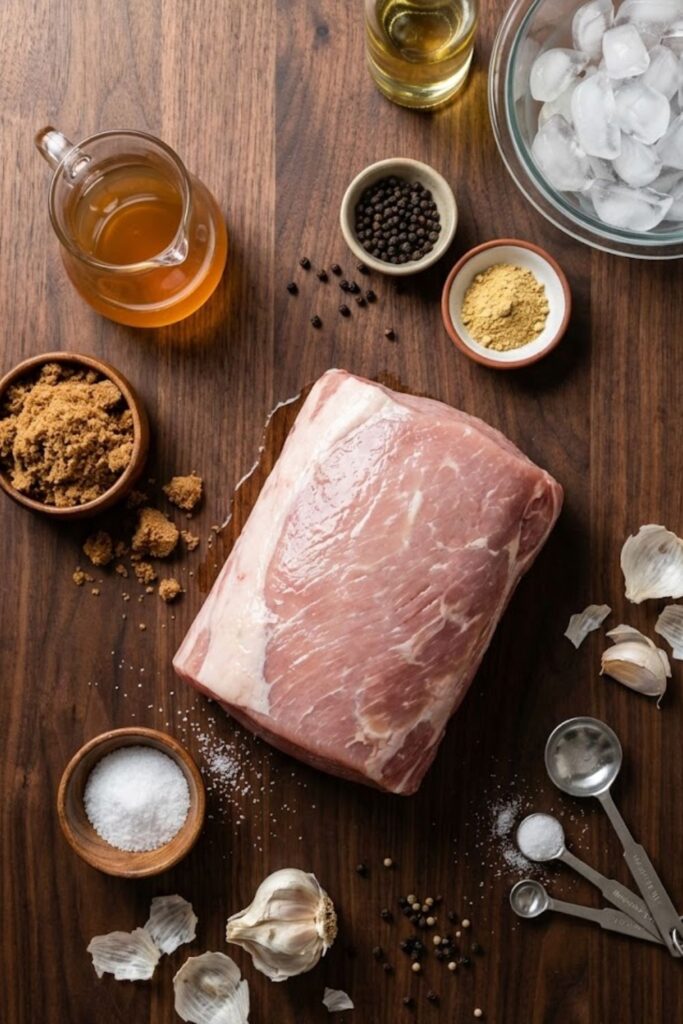
Alton Brown Roasted Pork Loin Ingredients
For the Brine:
- 1 cup boiling water
- 1/2 cup kosher salt (use Diamond Crystal; if using Morton, reduce to 1/3 cup)
- 1/2 cup dark brown sugar, packed
- 1 tablespoon whole black peppercorns
- 1 tablespoon dry mustard powder
- 2 cups apple cider vinegar
- 1 lb ice cubes
For the Roast:
- 3-4 lb boneless pork loin roast (not tenderloin)
- 1 tablespoon vegetable oil or canola oil
- Freshly ground black pepper, for seasoning
How To Make Alton Brown Roasted Pork Loin
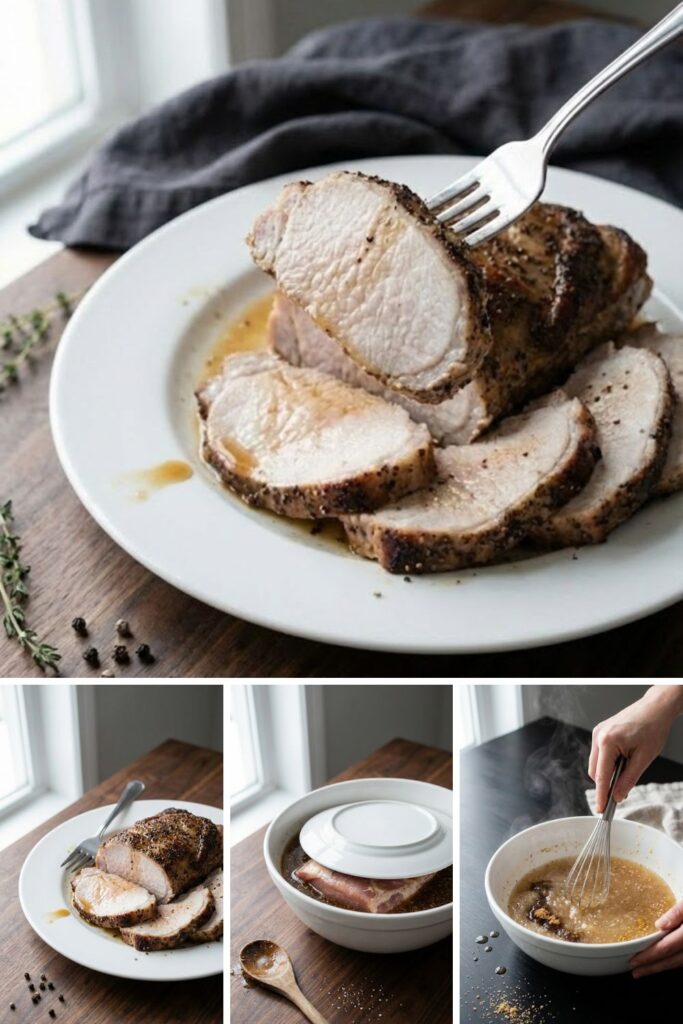
- Make the Brine Base: In a large heat-proof container or bowl, combine the boiling water, kosher salt, brown sugar, peppercorns, and mustard powder. Whisk vigorously until the salt and sugar are completely dissolved.
- Cool the Brine: Stir in the apple cider vinegar, then add the ice cubes. Stir until the ice melts and the liquid is cool to the touch. It is crucial that the brine is cold before you add the raw meat to prevent bacterial growth.
- Brine the Pork: Submerge the pork loin in the brine. If the meat floats, weigh it down with a heavy plate. Cover and refrigerate for at least 2 hours, but no more than 12 hours.
- Prep for Roasting: Preheat your oven to 350°F (175°C). Remove the pork from the brine and rinse it thoroughly under cold water to remove excess surface salt. Pat it completely dry with paper towels—this step ensures you get a good crust.
- Sear the Meat: Rub the dry pork loin with vegetable oil and season with fresh black pepper. Heat a large cast-iron skillet or roasting pan over medium-high heat. Sear the pork on all sides until golden brown, about 2-3 minutes per side.
- Roast to Perfection: Transfer the skillet directly to the oven (or move the pork to a roasting pan). Roast until an instant-read thermometer inserted into the thickest part registers 145°F (63°C), typically 45 to 60 minutes depending on thickness.
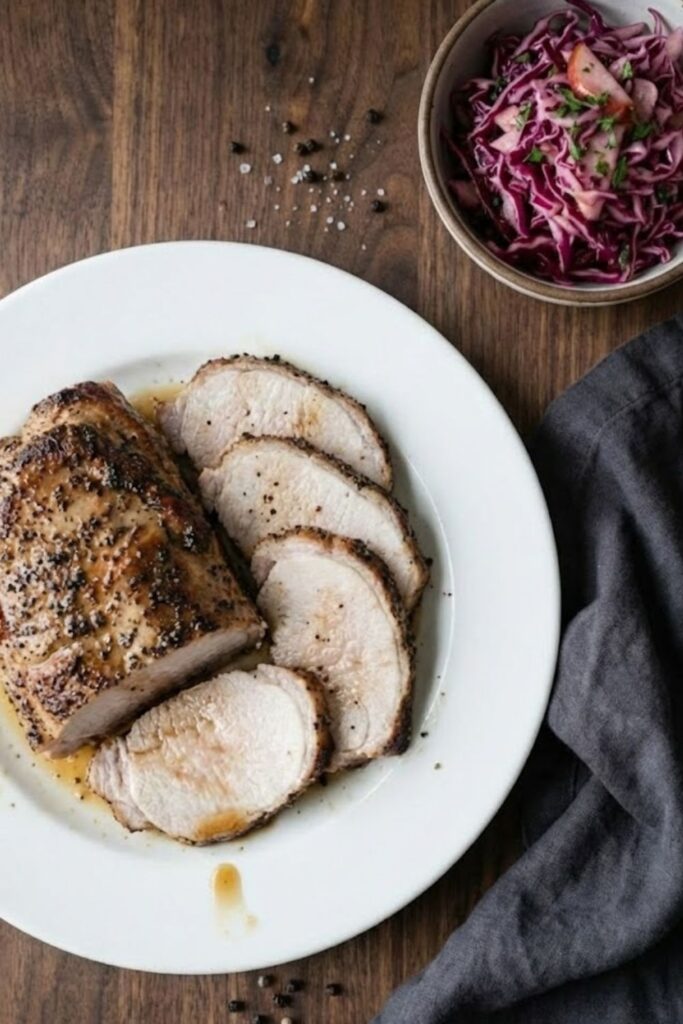
- Rest and Serve: Remove the roast from the oven and tent loosely with foil. Let it rest for at least 15 minutes before slicing. This allows the juices to redistribute throughout the meat.
Recipe Tips
- Rinse Well: Always rinse the pork after brining. If you skip this, the outside of the roast will be unpleasantly salty, even if the inside is perfect.
- Don’t Over-Brine: Unlike a turkey, a pork loin is relatively small. Leaving it in the brine for more than 12 hours can make the texture mushy and the flavor too cured, almost like ham.
- Use a Thermometer: Cooking times are just estimates. The only way to guarantee safety and quality is pulling the meat exactly when it hits 145°F.
- Room Temp Start: If you have time, let the pork sit on the counter for 30 minutes after brining and drying. A room-temperature roast cooks more evenly than a fridge-cold one.
What To Serve With Roast Pork
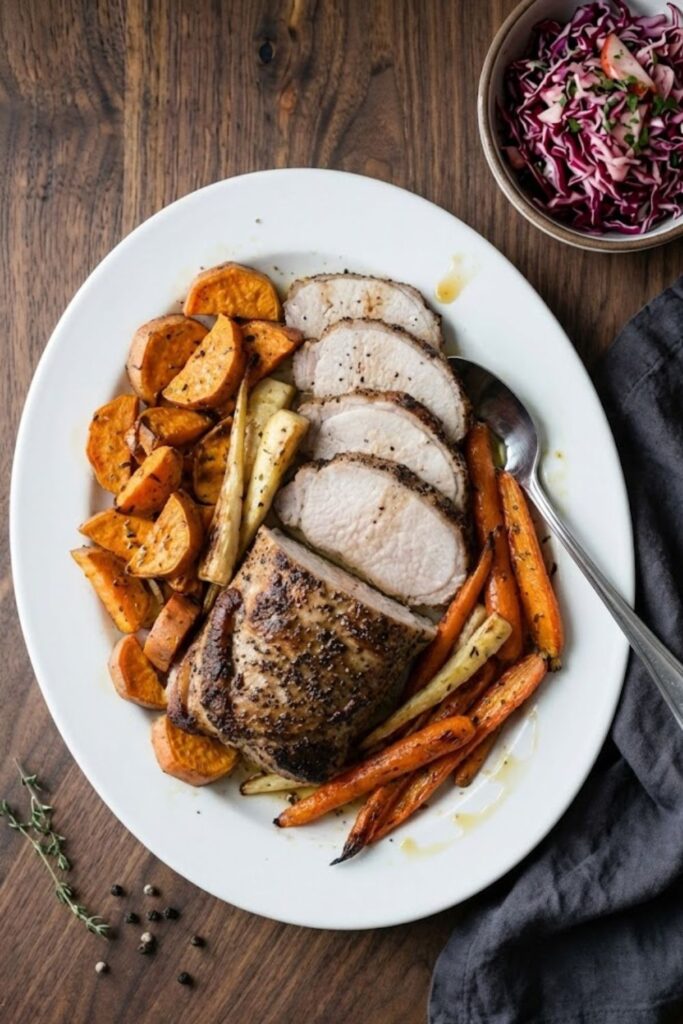
Since the oven is already on at 350°F, roasted root vegetables like carrots, sweet potatoes, or parsnips are a natural pairing. Simply toss them in olive oil and roast them on a separate tray for the same amount of time as the pork. A classic homemade applesauce or a tart apple cabbage slaw also cuts through the richness of the meat beautifully.
How To Store
Store leftover pork loin in an airtight container in the refrigerator for up to 3 days. It makes excellent sandwiches when sliced cold. You can also freeze slices in freezer-safe bags for up to 2 months; thaw gently in the fridge before reheating to avoid drying it out.
FAQs
Why is my pork loin dry?
Pork loin is a very lean muscle with little internal fat. If it turns out dry, it was likely overcooked beyond 145°F or not brined. The brine provides a buffer of moisture that keeps it juicy even if you accidentally leave it in the oven a few minutes too long.
Can I use table salt instead of kosher salt?
You should avoid using table salt for brining if possible. The grains are much denser, meaning a half-cup of table salt is far saltier than a half-cup of kosher salt. If you must use table salt, reduce the amount by half to avoid ruining the meat.
Is it safe to eat pork that is pink inside?
Yes, modern standards from the USDA state that whole cuts of pork are safe to eat at 145°F with a 3-minute rest time. At this temperature, the meat may still be slightly pink, which is desirable for texture and flavor.
Nutrition
- Calories: 340
- Total Fat: 14g
- Saturated Fat: 5g
- Cholesterol: 85mg
- Sodium: 680mg
- Total Carbohydrate: 4g
- Protein: 46g
Try More Recipes:
- Alton Brown Pork Adobo Recipe
- Alton Brown Pork Chops Recipe
- Alton Brown Grilled Pork Tenderloin Recipe
Alton Brown Roasted Pork Loin Recipe
Description
A technically optimized approach to roasting lean pork that utilizes a low-temperature brine for moisture retention and a multi-stage cooking process (sear then roast) to achieve a perfect crust and a juicy interior.
Ingredients
For the Brine:
For the Roast:
Instructions
- Dissolve the solutes: Combine the boiling water, salt, brown sugar, peppercorns, and mustard powder in a large vessel. Whisk vigorously until the salt and sugar are fully dissociated.
- Crash-cool the brine: Stir in the apple cider vinegar and the pound of ice. It is thermally imperative that the brine drops below $40^{\circ}F$ before the meat is introduced to maintain food safety protocols.
- Saturate the protein: Submerge the pork loin in the cold brine and refrigerate for 2 to 12 hours. The salt will travel into the muscle fibers via osmosis, while the vinegar slightly denatures the surface proteins.
- Dehydrate the surface: Remove the roast from the brine, rinse under cold water to eliminate excess surface sodium, and pat completely dry with paper towels.
- Preheat your oven to $350^{\circ}F$.
- Sear for flavor: Rub the pork with oil and pepper. In a heavy cast-iron skillet over medium-high heat, sear all sides (approx. 2–3 minutes per side). This initiates the Maillard reaction, creating a complex flavor profile that roasting alone cannot achieve.
- Roast: Move the skillet (or transfer the meat to a roasting pan) into the oven. Cook until an instant-read thermometer reaches $145^{\circ}F$.
- Rest: Remove the roast and tent loosely with foil for 15 minutes. During this time, carry-over cooking will likely bring the internal temperature up another 3 to 5 degrees.
Notes
- Brining lean pork loin is a structural necessity rather than a suggestion. The salt ions disrupt the tightly wound protein filaments (actin and myosin), causing them to unwind and trap water. This allows the meat to retain up to 10% more moisture even after the heat of the oven has induced contraction.
- The 15-minute rest period is essential for hydraulic equilibrium. When the meat is hot, the juices are under pressure and concentrated toward the center. Resting allows the muscle fibers to relax, permitting those juices to redistribute throughout the roast, ensuring they stay in the meat rather than on the cutting board.
- Target internal temperature is $145^{\circ}F$
. Modern USDA guidelines allow for this lower temperature (resulting in a slightly pink center), which is significantly more succulent than the older $160^{\circ}F$ standard that often resulted in a dry, “gray” texture.